
Azahrah
Six perfumes
Made by hand in the UK

The first smells I loved were not perfume.
Deccan, India, 17th century · Painted and resist-dyed cotton, 261 × 127 cm
The Metropolitan Museum of Art · Public domain
Before perfume
Chai gets boiled down on a burner until the milk turns brassy. Saffron goes into a pan and three threads colour the whole thing. A kulfi comes out of a steel mould cold enough to hurt your teeth. Somebody cracks a cardamom pod with a thumbnail because the pestle is in the sink.
None of that was sold to me as perfume. It was just the house.
The industry has a settled vocabulary for flowers, resins and woods, and almost nothing for the smell of a kitchen at eleven at night. I started Azahrah because I wanted the second list taken as seriously as the first.
- Chai boiled down until the milk goes brassy
- Kulfi out of a steel mould cold enough to hurt
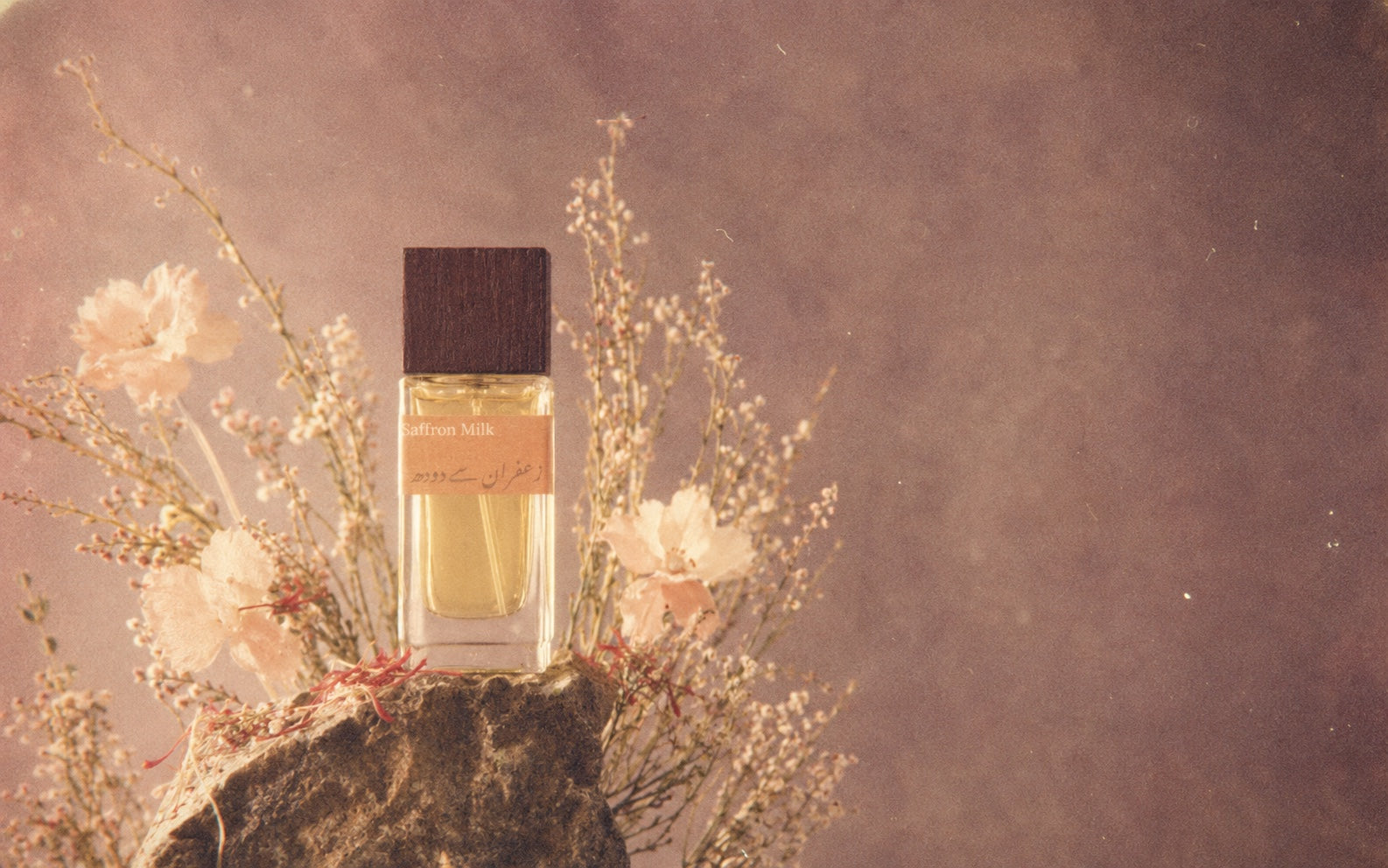
- Saffron in warm milk three threads, the whole pan
- Cardamom cracked with a thumbnail
- Pistachio, ground fine
- Rain landing on ground that has been hot all day
- Rose after that rain, not before it
Three of the six are desserts. People find that funnier than they find it interesting, and I have stopped explaining it.
Ways of looking

Ink, opaque watercolour and gold on paper · 38.6 × 26.5 cm
The Metropolitan Museum of Art · Public domain
This is a shamsa — a rosette painted at the front of an album, carrying the owner’s name. The page it sits on is thirty-nine centimetres tall, roughly a large hardback. Up close the rosette is dozens of separate flowers, every one of them finished. From the other side of a room it is a single calm circle.
That is the thing I keep going back to. All of the detail is there. None of it is loud.

Opaque watercolour and ink on paper · 59.7 × 80 cm
The Metropolitan Museum of Art · Public domain

A charbagh is a garden divided into four by two channels of water crossing at the middle. It is a plan you could set out with a ruler, and standing in one it does not feel like arithmetic at all — the geometry is holding something that is growing and wet and full of insects.
Order that stays alive is hard to make. It is more or less what I am doing when a formula is not working.
Charbagh · a garden in four parts, divided by water

The flowers on this page were cut out of paper and laid down by hand. The page has been damaged since, so half of them are missing an edge. Mughal painters worked small — a folio you can hold in two hands, looked at closely, by one person at a time.
The same flowers turn up carved into stone, woven into velvet, set into marble. A plant is observed hard, and then it becomes a surface you can lean on. That move, from looking at a thing to living inside it, is most of what I have taken from this material. Not a recipe. A way of paying attention.
Album page with cut-paper decoration
India, ca. 1625–50 · Cut paper on paper, opaque watercolour and gold · 26.7 × 18.1 cm
The Metropolitan Museum of Art · Public domain
Present tense
None of this is behind glass. Chai still gets made at eleven at night. Mithai still comes home in a pink box with string round it. Somebody is crushing cardamom right now with the flat of a knife.
I should be straight about the paintings on this page: they are art history, not lineage. I am not descended from a court perfumer and Azahrah is not the continuation of anything. I look at this work for the reason anyone does, which is that it is extraordinarily good — and because the way it treats one flower is closer to how I think about a formula than most perfume advertising is.
The perfumes come out of the present tense.
The making
The perfumes are made by hand in the UK.
That sentence does more work than it looks like it does. It means batches small enough that I smell every one of them. It means the oils move a little between seasons and I let them, rather than forcing this year’s material to behave like last year’s.
It means quality fragrance materials at extrait strength — thirty percent — with the full list printed on the box. Nothing hides behind the word parfum, and nothing is in there to make up volume.
It also means I run out. When a batch is finished it is finished until I make the next one.
One person
There is one person here.
That is not a boast about being small. It means nothing stands between an idea and a bottle except whether I think it is any good, and there is nobody else to hold responsible when a formula does not work. If something on this site is wrong, it is wrong in one particular way, on purpose or by accident, and either way it is mine.
The six
Chapter one The Originals
Almost everything on this page is ordinary. A pan, a tin, a wet street, a garden somebody measured out four hundred years ago and planted anyway.
I have never thought ordinary and small were the same thing.